At some point, you would imagine Cristiano Ronaldo might decide that he has had enough. Having emerged at Sporting, conquered England with Manchester United, terrorised Spain with Real Madrid and added a productive spell at Juventus, he could reasonably have retired several years ago without anyone suggesting that his career lacked substance. Five Ballon d’Or awards and five Champions League titles would generally be considered sufficient evidence of competence. Instead, he went to Saudi Arabia and continued scoring. The extravagant winger who once appeared determined to perform an entire Riverdance routine before delivering a cross has become a centre-forward with remarkably little interest in anything happening more than twenty yards from goal. It has been quite the career. Apparently, it still requires an additional entry.
That entry is his thousandth career goal. There is something wonderfully unreasonable about reaching the sort of total most professional footballers would require several reincarnations to approach and deciding that it remains annoyingly incomplete. I can appreciate the appeal, though. Nine hundred and something looks unfinished. A thousand has a pleasing finality to it, particularly for someone who has spent much of his adult life treating the record books as a personal checklist. Ronaldo has openly identified the milestone as a target and, given his history, dismissing that ambition would require the sort of confidence normally associated with a chairman announcing that his struggling manager retains the board’s full support.
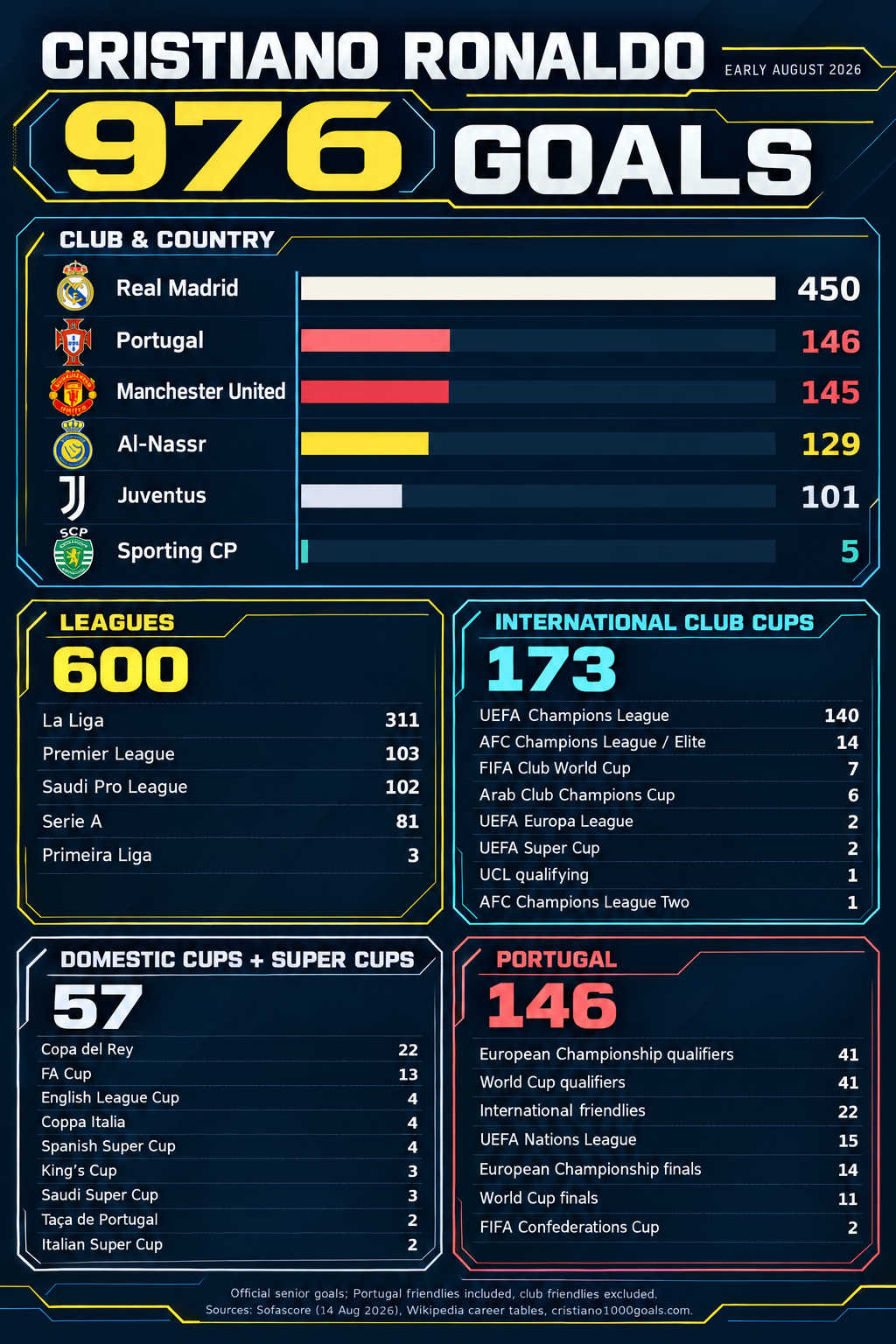
In early August 2026, he stands on 976 goals for club and country. Twenty-four to go. Written down, that looks almost reassuring. Twenty-four goals would represent an excellent season for most strikers, but Ronaldo has spent years making excellent seasons look suspiciously unproductive. At forty-one, he remains close enough to the finish line for the achievement to feel inevitable, provided his body continues to cooperate. That last part does a lot of work, rather. His dedication to physical conditioning is beyond dispute, but eventually even the most meticulously maintained machinery develops a fault. This usually happens just after the warranty expires and someone has assured you that it should comfortably last another year.
Which brings me to Football Manager 27 and my contribution to CR7’s proceedings. I intend to take charge of Al-Nassr and supervise those final twenty-four goals. Ronaldo’s immediate retirement announcement gives the exercise a deadline: one season to finish the job. There is an appealing absurdity to placing the final stages of this pursuit in my hands, given my dislike for actual strikers.
The difficulty will be giving him enough opportunities to reach the target while keeping him available to take them. I will need players who can supply him, teammates willing to do much of the running and the restraint to substitute him when another goal remains temptingly possible. Penalties should help, I mean, he is nicknamed Penaldo for a reason. Progress in the cups would provide additional fixtures, although those fixtures would also require me to keep sending a forty-one-year-old onto a football pitch. Portugal might contribute, but I would prefer the success of my season to depend on decisions I can actually make. The central problem is already clear enough: every match I rest him is an opportunity lost, while every match I play him carries the possibility of losing several more. Twenty-four goals sounds perfectly manageable until you find yourself negotiating with a hamstring.
Table of Contents
The tactical framework
The tactical framework began with a fairly simple requirement: give Cristiano Ronaldo enough opportunities to score the remaining twenty-four goals before his retirement. This immediately made his needs rather more important than my usual attachment to an aesthetically pleasing formation. I needed to consider where the service would come from, how he would attack it and what everybody else would do while he was attempting to add another line to his own Wikipedia page. Somewhere during that process, Kingsley Coman became my left-back. There are probably coaching qualifications that would have advised against this, but fortunately I was operating without supervision, not that I would’ve cared either way. Mentally deranged tactical stuff is like… kinda my thing…
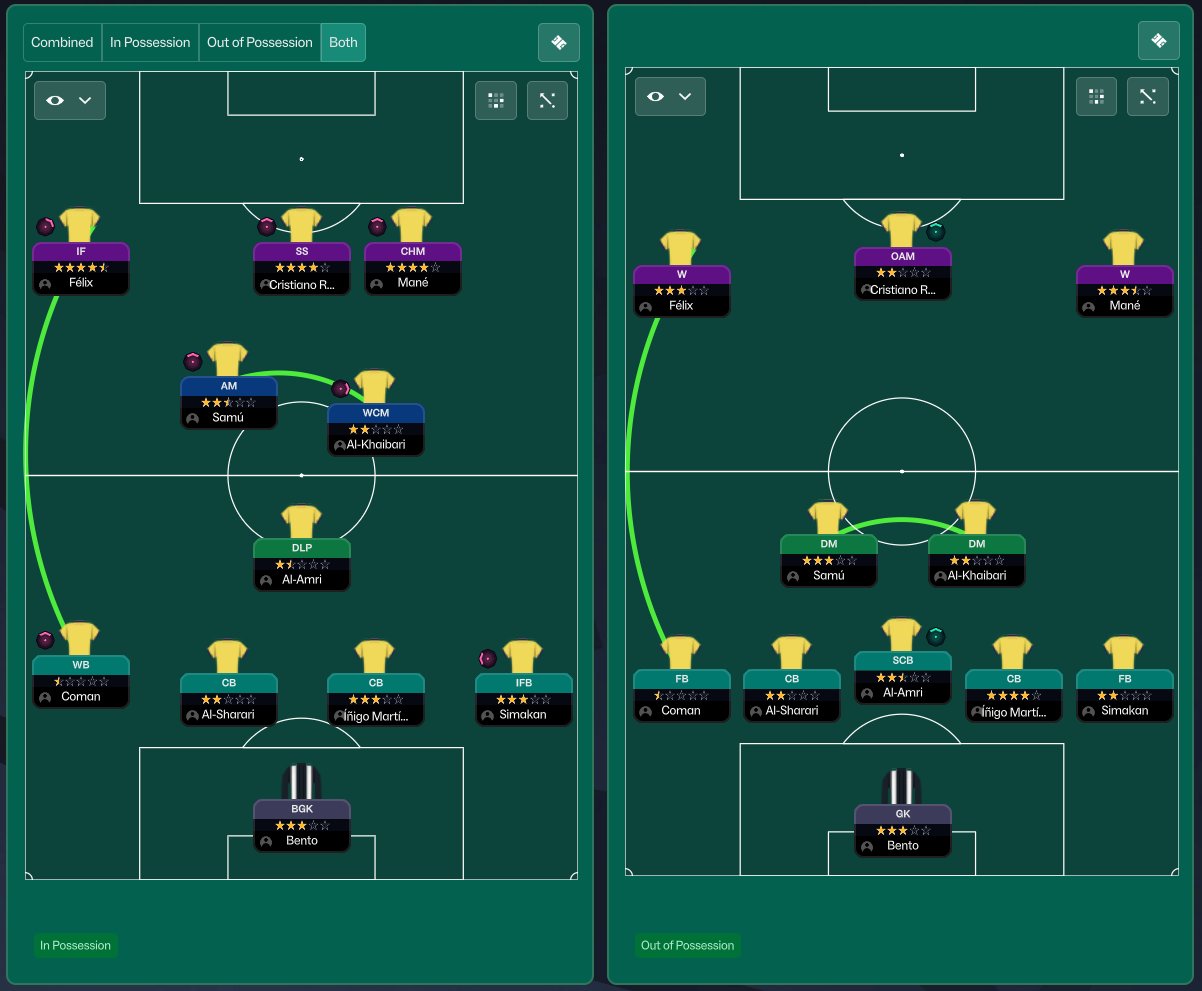
Coman’s selection as a defender was about getting another capable provider into the attack. I wanted him advancing down the left, where he could combine with Félix and deliver crosses towards Ronaldo. The distance between Coman’s starting position and Félix’s position higher up the pitch created room for that movement. Coman could advance into the gap as the attack developed, while Félix could move inside or come towards the ball to offer support. That gave me different ways of progressing down the flank without requiring somebody to stand permanently in every available space.
Félix’s involvement was particularly important because Coman was never supposed to operate as a solitary crossing machine. When Coman advanced with the ball, Félix either remained nearby to offer a short option and help overload the defence on that side, or he drew away defenders with his movement, creating space for Coman. I wanted the defender confronting Coman to have something else to worry about. Closing the delivery could leave Félix available; following Félix could give Coman more time to cross. A short exchange might also create a better angle than the one available when Coman first received possession. The objective was to manufacture useful deliveries, rather than accumulate crosses until the statistics looked sufficiently industrious.
My initial choice of delivery did not survive contact with Ronaldo’s legs. I started with driven crosses, which required him to reach the receiving position quickly enough to benefit from them. He struggled to do so. The service and the intended recipient were operating on slightly different understandings of his remaining acceleration. I changed to floated crosses to make greater use of his aerial ability, giving him more time to establish his position and attack the ball. Building an entire system around Ronaldo seemed a rather pointless exercise if its central requirement was that he should still be twenty-eight.
That adjustment came with a trade-off. A floated delivery also gives defenders time to organise, so simply hanging the ball above Ronaldo would hardly constitute an elaborate tactical breakthrough. The movement around him needed to create other problems. He was instructed to attack the near post, providing a clear target for the first delivery. From his central shadow-striker position, with no conventional striker ahead of him, I wanted him attacking towards goal and arriving in the area where the cross could be finished. The vacant space ahead was intended to accommodate his movement. Whether he could find separation from his marker would matter considerably more than how inviting that space looked on the tactics screen.
Mané started close to his right, providing another attacking presence around him. Part of the intention was to give Ronaldo nearby support so that he had less reason to wander away in search of involvement. I also wanted somebody positioned to benefit from knock-ons, loose balls and deliveries that travelled beyond the first contest. Mané’s proximity could help occupy another defender and provide a combination option, although it would be optimistic to assume that placing him nearby automatically fixed Ronaldo’s movement. That relationship still needed to work on the pitch. The arrangement was intended to support Ronaldo’s goalscoring, rather than quietly turn him into an unusually decorated assistant for somebody else.
Both Mané and Félix were instructed to attack the far post, but that does not mean they were expected to arrive there together. Their involvement depended on the location of the ball. When Félix crossed from the left, Mané attacked the far side. When Mané supplied the delivery from the right, Félix became the opposite-side runner. When Coman crossed from the left, Félix was usually close enough to offer the short option and help sustain the overload on that flank. The ball-side player therefore remained involved in producing the service, while the opposite attacker threatened beyond Ronaldo. The instructions make considerably more sense when viewed as part of a developing attack than as an appointment for two people beside the same goalpost.
Samu supplied the later arrival from midfield. Ronaldo attacked the near-post area, the opposite attacker threatened the far post and Samu entered after those initial movements had begun. That staggered the arrivals rather than sending everybody forward at the same moment. It also gave the attack a presence around the space behind the first contest, where a clearance, rebound or short pass might become useful. I wanted the defence to keep adjusting as the delivery developed, with different players entering its immediate concerns at different times. Ronaldo remained the principal target, but giving the opposition permission to ignore everybody else would have been an unnecessarily generous contribution to their preparation.
Coman’s freedom to advance was supported by a 3+1 rest defence. Simakan tucked in alongside the two centre-backs, with the defensive midfielder screening ahead of them. That left four players positioned behind the attack while Coman and the players further forward attempted to create the chance. The back three provided cover across the pitch, while the midfielder offered protection through the centre and a presence around second balls. This was the insurance behind the experiment. Selecting a winger at left-back was already a concession to the goalscoring objective; I saw little reason to accompany it with unrestricted access to our goalkeeper.
The effectiveness of that cover would still depend on distances and decisions. Three defenders and a midfielder can look reassuringly substantial until they are spread across enough grass to require separate postal addresses. If the left centre-back had to move across behind Coman, the remaining players needed to protect the space he vacated. Equally, recovering a clearance could help sustain the attack and produce another delivery before the opposition had fully reorganised. The rest defence therefore had a role in keeping Ronaldo supplied as well as protecting the other end. Repeated attacks were useful, provided we were the side making them.
Ultimately, the framework needed to be judged by the opportunities it created for Ronaldo. Coman’s crossing numbers would only tell part of the story. I needed to see where Ronaldo met those deliveries, whether the near-post movement gave him a realistic attempt and how the surrounding players affected the defenders marking him. The switch from driven to floated crosses was already a correction based on what I had watched. It established the principle for everything that followed: the tactic had to accommodate the Ronaldo available in this save. His reputation could attract all the attention it liked. It could not arrive at the near post on his behalf.
Keeping the old boy fit for duty
The other tactical consideration was keeping Ronaldo sufficiently functional to benefit from any of this. His natural fitness is exceptional, but I was reluctant to interpret that as a contractual guarantee of ninety minutes twice a week. Being remarkably well preserved at forty-one still leaves the fairly significant detail of being forty-one. Recovery between matches and the ability to maintain an effort throughout one are different considerations. I needed to manage both, particularly when the fixture list began suggesting that professional footballers should regard Wednesday as adequate preparation for Saturday.
My approach was to press from a mid to low block, keeping the team compact and choosing our moments to engage rather than asking Ronaldo to lead an exhausting pursuit of every opposition defender. Without possession, he remained the attacking outlet, with no requirement to follow the opposition back towards our own penalty area. The players behind him would absorb the defensive work, leaving him available when we recovered the ball. That also gave us somebody to find on the way out. The arrangement needed that escape route: sitting deep becomes considerably less economical when every clearance returns immediately and the entire team spends the afternoon defending another attack.
The intention was to concentrate his effort around the actions that might actually produce a goal. I wanted him moving to receive, combining with the players nearby and attacking the cross when it arrived. Those actions still demanded energy, but they were a more useful allocation of it than having him chase a centre-back towards the corner flag to demonstrate collective enthusiasm. There was little value in Ronaldo arriving at the next attacking opportunity having already spent his remaining acceleration trying to recover a ball somebody else had given away.
I also needed to pay attention to his condition during the match. Around seventy minutes became a useful checkpoint for considering a substitution, with an earlier change available if he deteriorated sooner. If his condition dipped into the red, I would look to replace him rather than assume his reputation could negotiate another twenty minutes. I would also watch the movement itself: whether he was still reaching the near post, responding to second balls and finding the positions the system was designed to supply. A player remaining on the pitch is not necessarily a player remaining effective. The temptation to leave him on for one more chance would always be there, but I needed Ronaldo available across the season. His retirement announcement had already supplied one deadline. I had no particular desire to bring it forward through enthusiastic mismanagement.
1 down, 23 to go
Having spent time arranging overloads, staggering runs and finding employment for Kingsley Coman at left-back, the first goal arrived from a penalty. Football occasionally has a rather limited appreciation of the effort you put into these things.
Ronaldo steps up and finishes right-footed, sending the goalkeeper the wrong way. The keeper commits to one side while the ball flies into the other, leaving him with an excellent view of somebody else’s contribution to football history. Ronaldo turns away and runs towards the corner, with his teammates following to join the celebrations. The entire business is completed with considerably less fuss than went into designing the system intended to supply him.
For this challenge, the method was perfectly acceptable. A penalty contributes exactly as much to the total as a beautifully constructed team goal, which is a reassuringly democratic arrangement when you are managing the countdown. One down. Twenty-three to go.
2 down, 22 to go
Having adjusted the crossing to accommodate Ronaldo’s ageing legs, he promptly scores by running behind the defence. Apparently, my tactical diagnosis required a second opinion.
The move develops from deeper possession before Mané receives on the right and releases the ball into the space ahead of Ronaldo. He accelerates through the middle, gets beyond the retreating defenders and reaches the penalty area with the goalkeeper coming out to meet him. The finish beats the advancing keeper, leaving the defenders to complete their recovery runs in the traditional manner: arriving after the interesting part has finished.
There is something useful here beyond the embarrassment of my earlier assessment. Ronaldo has space to attack, a teammate who finds his run and enough separation to finish. He does not need to win every footrace, just this one. Either the old boy has something left, or the defenders need servicing. Two down. Twenty-two remaining.
3 down, 23 to go
The third goal involves Ronaldo reminding his marker that retirement has been announced, rather than completed. There is a difference, and the defender receives a demonstration.
After we work the ball around outside the penalty area, Mané finds Ronaldo towards the right side of the attack. He takes the ball beyond his marker, moves into the box and finishes calmly past the goalkeeper. The defender is left chasing the situation after Ronaldo has decided how it should end. It is a lovely reminder that close control and an understanding of where the space will appear remain useful professional qualifications.
For all my planning around crosses, the opening three goals have now included a penalty, a run behind the defence and this individual contribution. Ronaldo is finding several ways to make the countdown move, which is considerably more helpful than obediently waiting for my preferred delivery. Three down. Twenty-one to go.
4 down, 22 to go
By the fourth goal, Ronaldo appears to have developed an objection to my concerns about his mobility. Completing a hat-trick is an effective way of expressing it.
We build down the right, where Mané has the ball and Ronaldo waits for the opportunity to attack behind the defensive line. The pass comes infield, Ronaldo times his movement to beat the offside trap and suddenly the defenders are facing their own goal. He reaches the ball inside the penalty area and finishes precisely past the goalkeeper. The attempted trap leaves the opposition looking rather like a committee whose members have all read different versions of the agenda.
The useful detail is the timing between the pass and the run. Ronaldo gives the ball carrier a forward option, then reaches the receiving space with enough freedom to finish. Another goal from movement behind the defence. A hat-trick secured. Four down. Twenty remaining.
5 down, 21 to go
The fifth goal finally gives me something to put beside the paragraph about floated crosses. Ronaldo has been scoring perfectly happily without consulting the tactical brief, but occasionally it is nice to look as though I am involved.
The ball is worked down the right before a floated delivery comes into the penalty area. Ronaldo rises above his marker and steers his header towards the far post, beyond the goalkeeper. The defender competes, but ends up providing little more than a useful reference point for how high Ronaldo has jumped. Excellent delivery, a properly directed header and another entry in the ledger.
This is why we changed the crossing. Give him height and time to attack the ball, and his aerial ability can do the damage without requiring another sprint beyond the defence. Five down, nineteen remaining. Fortunately, Ronaldo’s finishing is proving considerably more reliable than my ability to count.
6 down, 20 to go
After the aerial demonstration, we return to the penalty spot. Ronaldo converts, celebrates and makes another contribution to a challenge whose aesthetic standards become remarkably flexible whenever the referee points towards twelve yards. There is little here to validate my carefully constructed attacking framework, but the spreadsheet remains enthusiastic. Six down, eighteen remaining. Nobody reaching a thousand career goals is going to request an audit because some of them involved a stationary ball.
7 down, 19 to go
A quick combination releases Ronaldo through the middle, leaving him one-on-one with Mignolet. He finishes, while the defenders discover that maintaining roughly the correct postcode is insufficient when marking Cristiano Ronaldo.
The useful detail is how quickly the passing creates the opening. Ronaldo can attack the space before the opposition reorganises, giving him a clear chance without demanding a lengthy sprint. Our supposedly immobile pensioner continues finding opportunities behind the defensive line. Seven down, seventeen remaining.
8 down, 18 to go
Having changed the crossing because Ronaldo struggled to reach driven deliveries, he now scores from a low cross. Naturally. Félix sends the ball into the danger area, Ronaldo reacts ahead of his marker and finishes from close range.
This complicates the earlier diagnosis in a useful way. A low delivery can still work when the service and movement coincide; the initial failures hardly amounted to a lifetime prohibition. Ronaldo gets there first because he anticipates the opportunity. The defender appears to require written notice. Eight down, sixteen remaining.
12 down, 14 to go
Four games without scoring had given me ample time to investigate whether I had finally broken Cristiano Ronaldo. He responds by scoring four in one match, displaying the restraint of somebody settling an argument in the family WhatsApp group.
The post contains all four finishes, presented in reverse match order. The earliest comes from Mané releasing Ronaldo into space, another reminder that a well-timed forward pass remains useful. The subsequent deliveries into the box bring his aerial threat back into the picture, with Ronaldo attacking the service while blue shirts gather around him without resolving the underlying problem.
This is the range of supply we wanted: passes into space when the opening appears, crosses when we can exploit his strength in the air. Four barren matches, then four goals. Twelve down, twelve remaining. Halfway there, with my blood pressure taking the scenic route.
13 down, 13 to go
João Félix provides the clever touch, Ronaldo supplies the conclusion. The flick-on redirects the attack quickly enough to give Ronaldo an opportunity before the defence can adjust, and he finishes. Having initially built this system around Ronaldo winning aerial duels, I am perfectly happy to discover that somebody else can occasionally handle the preliminary paperwork. The supporting attackers are there to create chances for him, and Félix obliges.
14 down, 12 to go
Ronaldo makes another well-timed run beyond the defensive line and finishes, further damaging my reputation as somebody capable of assessing his mobility. The movement gives him the advantage before the defenders can recover. He does not suddenly possess the acceleration of his younger self, but recognising when to move remains a useful substitute. I had prepared a retirement home with crossing facilities. He keeps requesting access to the fast lane.
15 down, 11 to go
Another forward pass, another intelligent run and another goalkeeper left dealing with Ronaldo at an inconvenient distance. He attacks the opening through the middle and finishes before the recovering defenders can make themselves useful. These opportunities are becoming a recurring feature of the attack. Ronaldo offers the movement, his teammates increasingly find it, and the opposition provides the reaction shots. The thousand-goal target is beginning to look considerably less theoretical.
16 down, 10 to go
A low driven cross reaches Ronaldo, who finishes from close range and gives my earlier tactical assessment another small kicking. These deliveries caused problems initially, but this time the service and his arrival coincide. That distinction matters. We changed the crossing to improve his supply, while this goal shows that other deliveries can still produce chances. Unfortunately, football continues refusing to organise itself around the absolute statements that make articles easier to write.
17 down, 9 to go
This attack has something of futsal about it: nearby passing options, quick combinations and defenders repeatedly having to change whom they are worried about. The ball is worked into a position from which Ronaldo can finish with a simple tap-in. The finish requires little ceremony because the preceding movement has done the difficult work. There is considerable satisfaction in making a professional defence look as though somebody has quietly removed the assembly instructions.
18 down, 8 to go
The initial effort comes back into play, and Ronaldo reacts to finish the rebound. While others are still processing the first attempt, he has already identified the next opportunity. This is another reason to keep him close to goal: his anticipation can turn an untidy situation into a straightforward finish. The attack briefly loses its elegance, but Ronaldo tidies up. I am chasing a numerical milestone, so the artistic director can lodge a complaint.
19 down, 7 to go
Iñigo Martínez ventures forward with the ball and slides a pass through for Ronaldo, who attacks the space and finishes past the advancing goalkeeper. Apparently, the centre-backs have decided that supplying this project is a collective responsibility. The useful feature is the connection between the forward carry and Ronaldo’s movement: Martínez has a runner to find when the opening appears. Another chance created through the middle, with the crossing department temporarily allowed its lunch break.
20 down, 6 to go
Another penalty allows Ronaldo to make a modest contribution to the discourse surrounding the name “Penaldo”. He converts, the goalkeeper ends up on the turf, and the countdown advances. I imagine somebody somewhere considers this an inferior form of goalscoring, but I have neither the time nor the remaining fixtures to accommodate their objections. When the objective is a thousand goals, declining penalties would represent an unusually committed form of self-sabotage.
21 down, 5 to go
An early ball from wide sends Ronaldo into space, and his run gives him the opportunity to finish. The delivery and movement look increasingly coordinated, which matches my impression as tactical effectiveness improves. That remains an observation rather than proof of the cause, but it is an encouraging one. Ronaldo appears better connected to the service around him. My initial solution was to change the delivery; the developing understanding may also be helping him reach it.
25 down, 1 to go
Ronaldo rises above the defenders and heads home, bringing the total to 999. After all the runs behind, combinations and opportunistic finishes, his aerial ability brings us within one goal of the target. The delivery gives him a ball to attack, and he supplies the elevation and direction. His marker participates in the scene without exercising much influence over it. One remaining. Suddenly, every subsequent attack feels like it should arrive accompanied by a drum roll.
Finito!
Mané delivers the cross, Ronaldo meets it with his head, and the ball beats the diving goalkeeper. One thousand career goals. After the tactical adjustments, the fitness management and an increasingly embarrassing struggle with basic arithmetic, the decisive moment comes from the sort of service we wanted to provide.
There is something rather satisfying about that. Ronaldo has repeatedly demonstrated that he can score through several different routes, but the milestone arrives through his aerial strength. Mané supplies him, he finishes, and the retirement announcement finally becomes somebody else’s administrative problem.

Guido is the founding father of Strikerless and main nutjob running the show.


0 Comments